Catch basins collect at a low point
A basin typically belongs at a defined low spot where runoff converges. The grate is only one part of it: sump space, outlet arrangement, pipe grade and accessibility also determine whether debris can settle and be removed without disassembling the system.
Channels collect along a paved edge
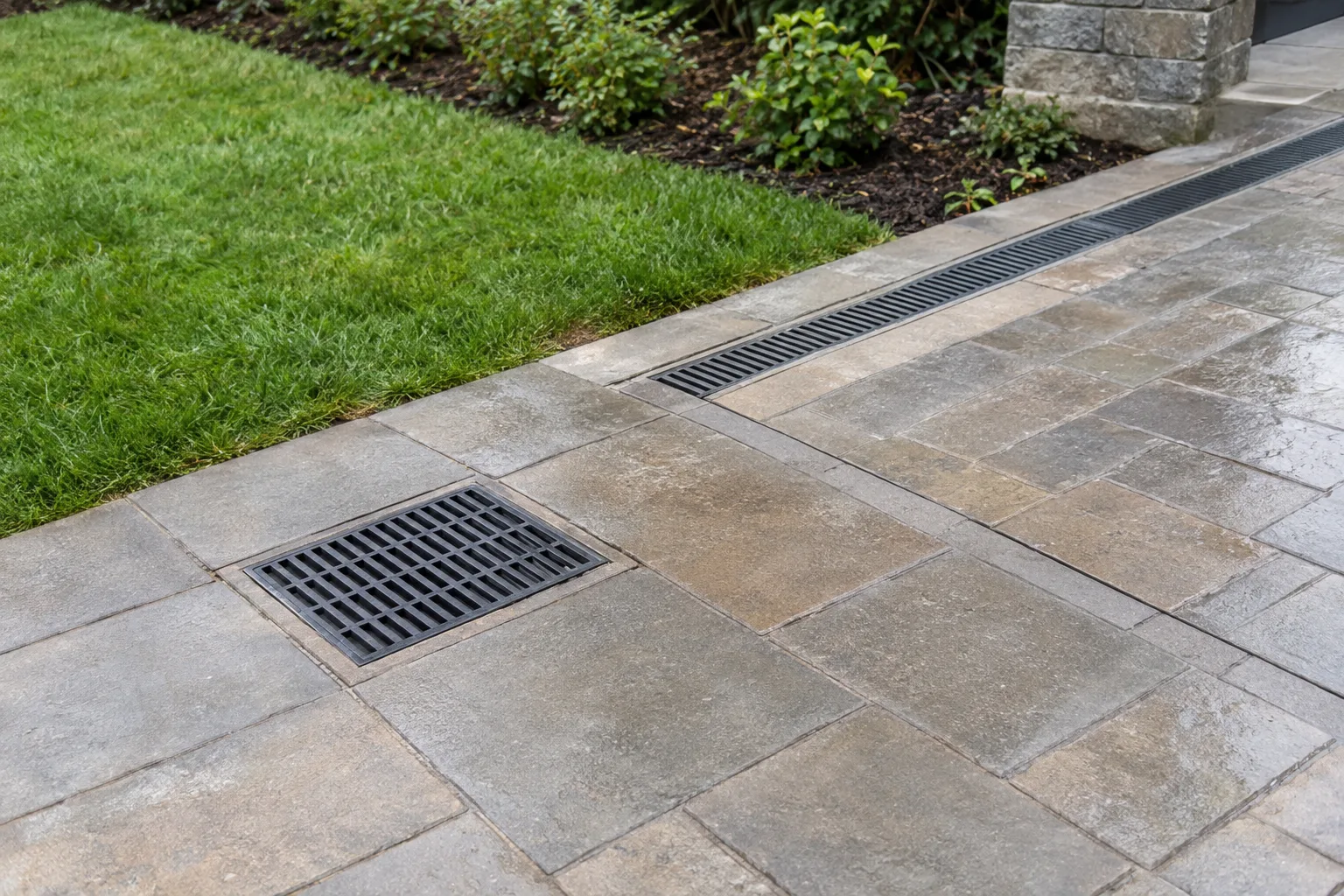
A trench or channel drain is useful where flow crosses an extended threshold, such as the approach to a garage or the edge of paving. Grate load rating, traffic exposure, channel support and transitions to adjacent concrete matter in addition to hydraulic collection.
Match the inlet to the surface
On a lawn, a narrow linear grate may be unnecessarily difficult to keep free of mulch or grass clippings. A well-located point inlet may be easier to maintain. Conversely, a single basin on a long driveway can miss sheet flow until water reaches an undesirable location.
Both need a working outlet
Both devices rely on a downstream route. Connecting either into a flat, silted or undersized pipe can leave water at the grate. The elevation of the pipe outlet and its ability to discharge during the same storm determine much of the actual performance.
Leave room for cleaning
Maintenance differs: basins can accumulate sediment below the outlet; channels trap debris along their length and may require removable grates. Plan cleaning access before permanent paving or landscaping makes the inlet difficult to reach.
Choose from the site conditions
In Arlington, decide from the surface contours and legal discharge, not just by preference for a tidy-looking product. The city describes private area drains as one possible solution while emphasizing proper grade and drainage-system design.
How the clues change the decision
Suppose a sloping driveway delivers sheet flow along the entire face of a garage. A single point basin near one side may be bypassed because water does not converge at that location. A properly designed linear channel might intercept the moving sheet at the threshold, provided the grate can withstand expected loading and the outlet has workable fall. Now change the example: runoff from lawn and patio converges into a small back corner, well away from traffic. A point basin could be simpler to maintain than a long grated channel. In both cases, choosing an inlet only solves collection. If the buried route is obstructed or its termination is submerged, neither inlet type will produce the intended result. The responsible choice uses observed flow geometry, finish elevations, anticipated debris and a clear discharge strategy.
Choose a point or a line of collection
We compare where runoff converges with where it crosses a boundary. A point basin can collect several small flows if the surrounding ground brings them into one low spot. A channel can interrupt water moving across a wider paved edge. The visible area of the grate alone does not tell us which is better. If water never reaches an opening, additional capacity there will not help. We check the actual surface levels and approach routes before deciding whether the collection should be concentrated or spread along a line.
Existing paving can make that choice more practical or more difficult. A basin set into a low corner may involve a smaller surface opening, but the pipe still needs a route out. A channel across a driveway may intercept a broad flow while requiring a longer concrete cut and support suited to vehicles. We discuss those construction differences alongside collection performance. On an Arlington property with fixed thresholds or narrow access, the installation constraints can be as important as the shape of the puddle.
Include the connection and cleaning requirements
Both systems concentrate collected water into an outlet route. We check whether the connected pipe can empty and whether an existing line is suitable before adding another inlet. A channel with a clean trough can still overflow if its outlet is restricted. A basin may stay full when the downstream receiving point is too high. Those symptoms should lead to investigation of the complete route rather than a simple recommendation to replace the grate with something larger.
Maintenance also differs. A basin provides access at a point where sediment may settle; a channel gives access along a trough that can collect leaves and grit. Grates need to be removable and appropriate for the expected traffic. Landscaping should leave working space around them. When comparing estimates, look for the same pipe connection, outlet work and surface restoration, not just similar inlet lengths or sizes. A complete plan explains why the chosen collector fits the water path and how you will reach it when cleaning is needed.
An overflow observation can help explain the choice. If water passes around the end of a channel, collection length or surface direction may need attention. If water surrounds a basin but cannot enter, the grate height or obstruction may be the issue. If either collector fills from below, we investigate the downstream route. These patterns lead to different corrections, so a larger opening should follow the findings rather than replace them.