An isolated defect may be repairable
A crushed pipe, obstructed grate, disconnected downspout or damaged emitter can be relatively isolated. Locating the actual defect before demolition may allow only a short trench or component to be opened. The key question is whether fixing that part will let the rest of the system drain properly.
Repeated trouble may point to the layout
Long-term ponding may be a design symptom rather than wear. Lines laid too flat, chronic sediment from upstream soil, repeated root interference and an outlet submerged at ordinary rain levels can defeat successive repairs. Cleaning a section cannot manufacture missing gravity fall.
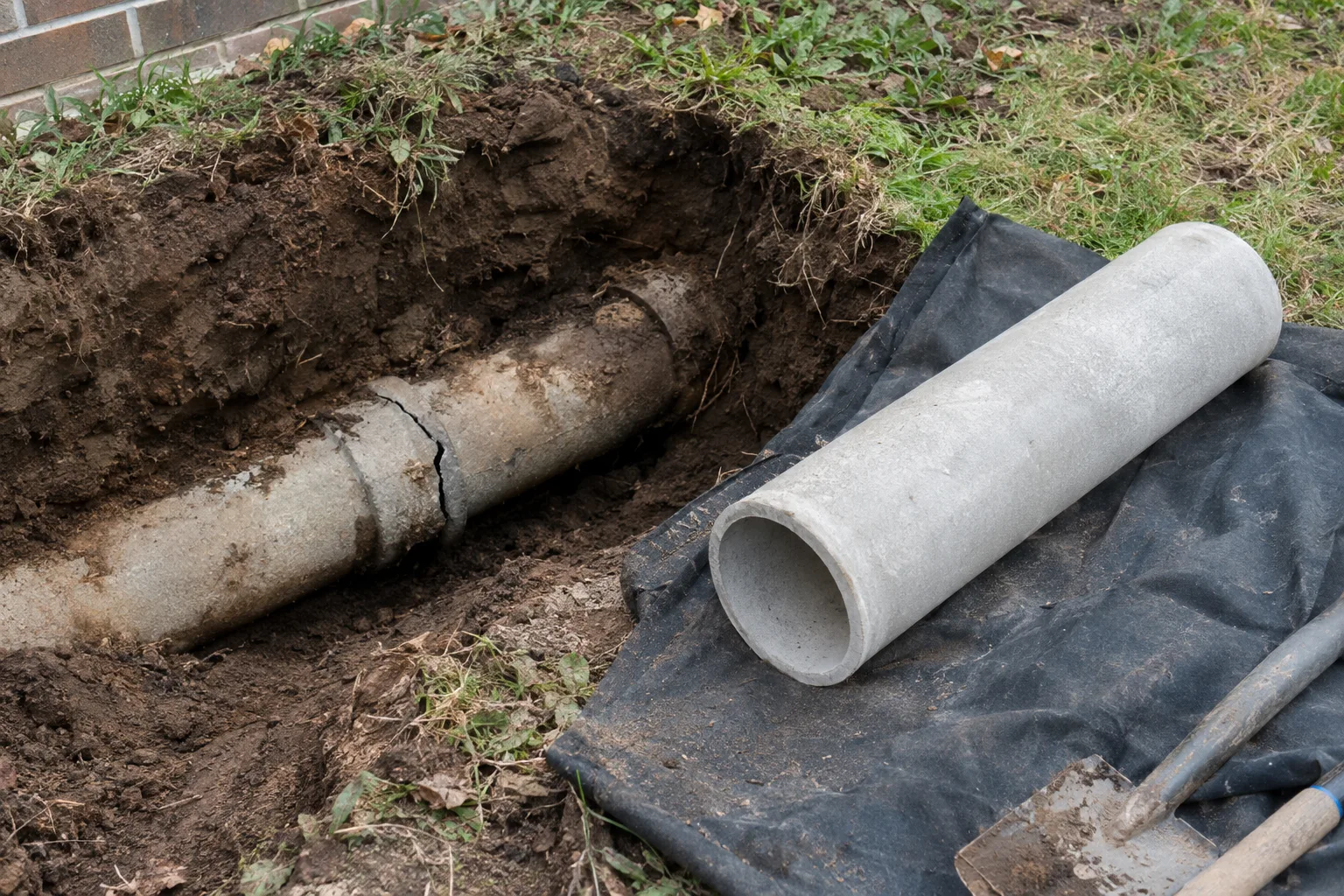
Ask what the inspection established
Before agreeing to a repair, ask what the inspection found, how the downstream route was tested and whether the pipe is compatible with the replacement fitting. For a replacement, ask how the proposed layout changes the limiting factor instead of merely supplying new materials.
Check changes around the old drain
The area around a pipe can change. Driveway additions, new planting beds and settlement after construction may redirect water in ways the original drain was not designed to handle. Work that began as a blocked basin call might require modest regrading rather than full pipe replacement.
Account for access and restoration
Access affects both choices. Under a patio, retaining wall or mature tree, preserving finishes may justify more careful investigation. Excavation might still be unavoidable where a buried defect cannot be reached safely or a new grade must be established.
Compare what each option will fix
Compare scope documents that show the beginning and end of work, retained components, restoration obligations and the planned outlet. A cheaper repair that leaves the root cause unaddressed is not necessarily the lower-cost decision over time.
How the clues change the decision
Consider two lines with similar water backing up at a basin. In the first, a reachable outlet has been buried beneath mulch and can be uncovered without disturbing the rest of the pipe. In the second, several connected sections have settled so that water stands in the line even when the outlet is open. Both may produce a puddle at the same grate, but the correct scope differs. The first may need cleaning and restoration of its exit. The second may require new grades or a redesigned path; replacing a single fitting would not remove the sag. Before choosing between repair and replacement, an assessment should map the retained components, distinguish known defects from assumptions, and estimate disturbance to paving or landscaping. A cheaper quote that does not solve the actual restriction may be more expensive in the long run.
Keep the useful parts when the layout works
We separate the condition of individual components from the usefulness of the overall route. A cracked connection can be a local repair when the surrounding line and outlet still function. A system with sound pipe but no workable discharge point may need a different layout. Age alone does not answer that question. We ask what the inspection found, whether the system previously worked and what changed. Those findings provide a stronger basis for a repair decision than either a blanket preference for new pipe or repeated cleaning without a diagnosis.
Access can change the comparison. A damaged section beside a reachable basin may be straightforward to expose, while the same defect beneath a driveway involves surface removal and restoration. We discuss the extent of that disturbance with both options. Replacing additional sound material is not automatically justified by difficult access, but opening the same surface repeatedly can also affect the owner's decision. A useful proposal explains the condition evidence and the practical tradeoff instead of presenting the larger scope as the only responsible choice.
Compare what each estimate actually fixes
A repair estimate should identify the defect it addresses. A replacement estimate should explain which limitations the new route or materials will correct. If both simply list pipe lengths, ask for the reasoning behind them. Repeated sediment buildup may need an upstream source addressed; a settled section may need corrected support and alignment; a covered outlet may need restoration of access. Each requires different work. We tie the recommendation to the observed cause so the owner can see why the proposed scope should perform differently from the current system.
There can still be uncertainty before excavation. The estimate should explain what is known, which buried conditions remain unconfirmed and how additional findings will be discussed. After the work, accessible connections and flow can be checked before restoration, with later storm observations helping assess the surface route. Keep a record of what was repaired and where. If another symptom appears, that record helps distinguish a remaining defect from a new runoff source rather than treating the whole system as an unexplained failure again.
If an estimate offers both options, compare the remaining limitations explicitly. A focused repair may restore one connection while keeping the existing route and access. A redesign may change those features but disturb more lawn or paving. We explain that difference so the decision is based on what each option resolves, with its restoration requirements understood.