A dry well needs soil that absorbs water
An infiltration chamber or aggregate reservoir must release captured water into surrounding soil. If the soil is already saturated or infiltrates slowly, stored water can remain through the next rain event. A bigger chamber may delay overflow but cannot change the underlying infiltration rate.
Conditions vary from lot to lot
Clay content is not uniform across Arlington. City materials describe comparatively clayey conditions in some eastern and southeastern areas, but fill, compaction, landscaping and subsurface layers differ lot to lot. A citywide soil label is not a sufficient basis for designing an infiltration system.
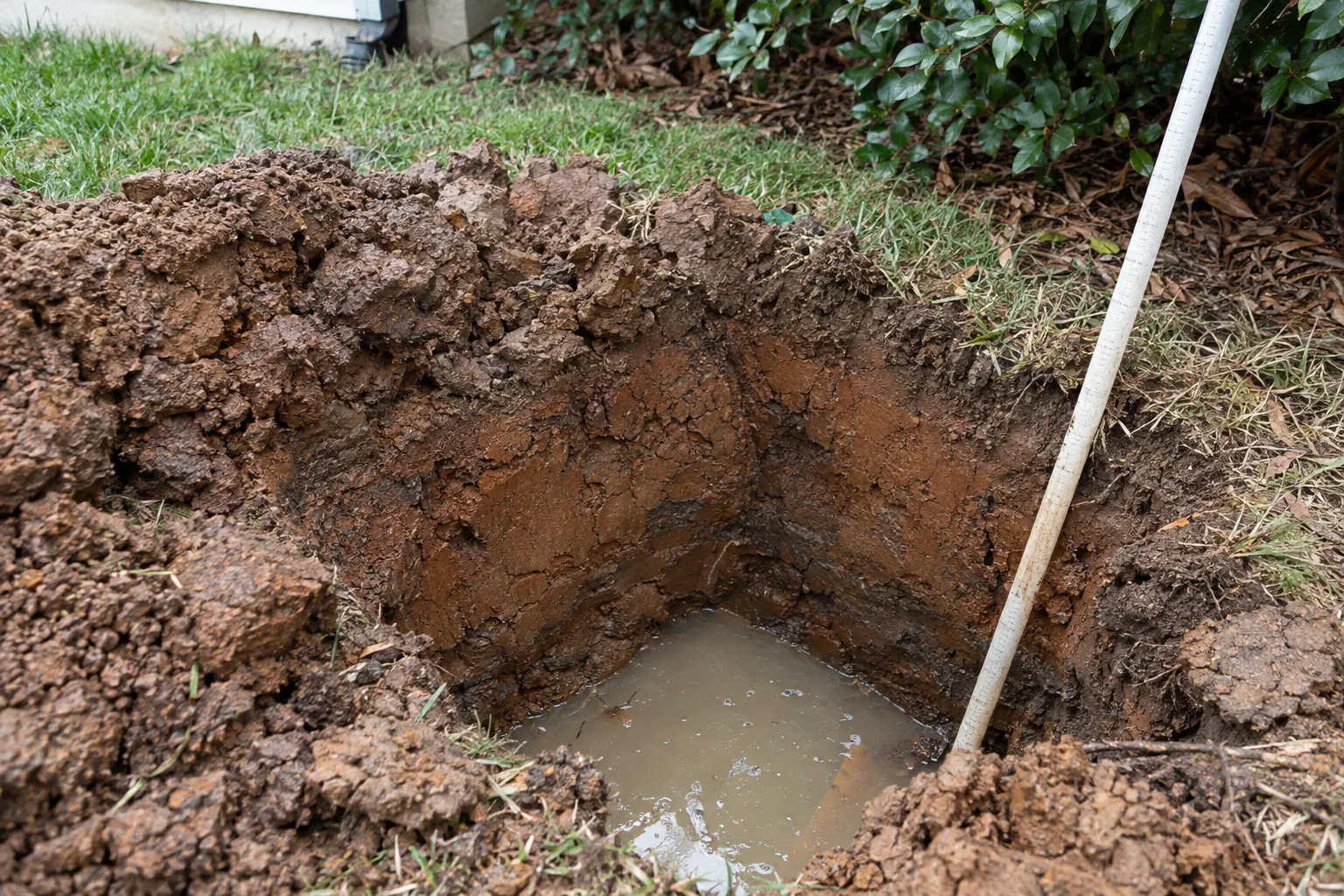
Check runoff, infiltration, and space
Check the roof or hardscape area contributing water, the volume expected during storms, the rate at which test water leaves suitable soil, and whether high groundwater or a nearby foundation narrows the safe location options. Soil tests must be performed under appropriate conditions rather than inferred from a surface observation.
Provide a route for overflow
An overflow plan is essential because no infiltration device absorbs infinite runoff. If water escapes beside the foundation, raises groundwater near a structure or surcharges a connected downspout, the installation can make a nuisance worse instead of better.
Consider other drainage options
Alternatives may include positive surface grading, a shallow swale, a catch basin tied to an acceptable downstream point, or a limited rain garden where suitable. The tradeoff is site access, appearance, open space, maintenance and allowable outlet arrangements.
Ask what supports the recommendation
Before asking for a dry-well price, request the sizing assumptions and evidence for infiltration. A responsible recommendation should explicitly describe circumstances in which the proposed dry well would not perform as expected.
How the clues change the decision
Imagine sizing an infiltration chamber based only on an online description of clay soil. During the first storm, the chamber fills. A second storm arrives before the surrounding ground has absorbed the stored water, and the downspout begins overflowing near a wall. This is the failure mode an infiltration evaluation is meant to prevent. A credible design considers contributing roof area, local infiltration at installation depth, storage volume, groundwater, setbacks and an overflow route. If field conditions do not support absorption, increasing chamber size is not a substitute for selecting a different discharge method. Arlington soils vary, so neither a citywide clay claim nor a single surface sample proves the behavior of that location.
Separate storage capacity from absorption
A storage chamber can hold only a limited amount of water at one time. Whether that capacity is available for the next storm depends on how quickly the surrounding ground accepts the previous runoff. We consider both questions before discussing size. If the soil remains saturated, a larger chamber can still fill and stay full. That is why a product's storage volume cannot establish suitability by itself. The design needs evidence about the proposed ground and a clear explanation of how the system recovers between rain events.
Testing should relate to the location and depth of the proposed installation. Compacted fill or a restrictive layer can behave differently from a garden bed a few feet away. Arlington soil descriptions help identify questions, but they cannot replace site assessment. We also consider the area supplying runoff and whether that contribution may change. Connecting more downspouts later can add water beyond the original plan even if the chamber remains in good condition. Keep the intended contributing area clear when comparing options.
Have an alternative when infiltration is unsuitable
We compare available surface and pipe routes when absorption is uncertain or inadequate. A swale may carry runoff across the ground where useful fall exists. A basin and solid line may connect a fixed low point to a suitable destination. Those alternatives have their own access and outlet limits, so the comparison needs complete routes rather than isolated components. The point of evaluating infiltration is to select a method the property can support, including deciding against a dry well when the evidence calls for another approach.
For a suitable dry-well proposal, ask how sediment is kept out, which components remain accessible and where excess water goes. Overflow near a building or onto vulnerable ground can undermine the benefit of the storage. The estimate should also identify excavation, soil removal, connections and restoration. We explain which findings support the recommendation and what conditions could change it. If water later remains in the system unusually long, that calls for checking both maintenance and soil recovery rather than assuming another chamber will automatically solve the problem.
A useful comparison also includes long-term access. Ask where debris can be removed before it reaches underground storage and how a problem would be investigated after the yard is restored. An installation that cannot be reached for routine service can be difficult to assess when it stops recovering between storms. We consider that maintenance route alongside soil suitability, so the choice is based on how the whole system will function after construction, not only how it fits in the excavation.