First, identify the kind of water problem
Start by observing the water: a sheet moving across lawn or pavement is surface runoff; damp soil emerging along a slope may be subsurface seepage; a single depression receiving several flows is a collection-point problem. These conditions can overlap after a large storm, so use observations from more than one event.
Grading changes the surface route
Grading changes the terrain itself. It can create a continuous fall away from a building or shape a broad, mowable swale. It is constrained by doors, walks, accessible routes, established trees and property boundaries. Adding soil against siding or changing a driveway elevation can create a different problem.
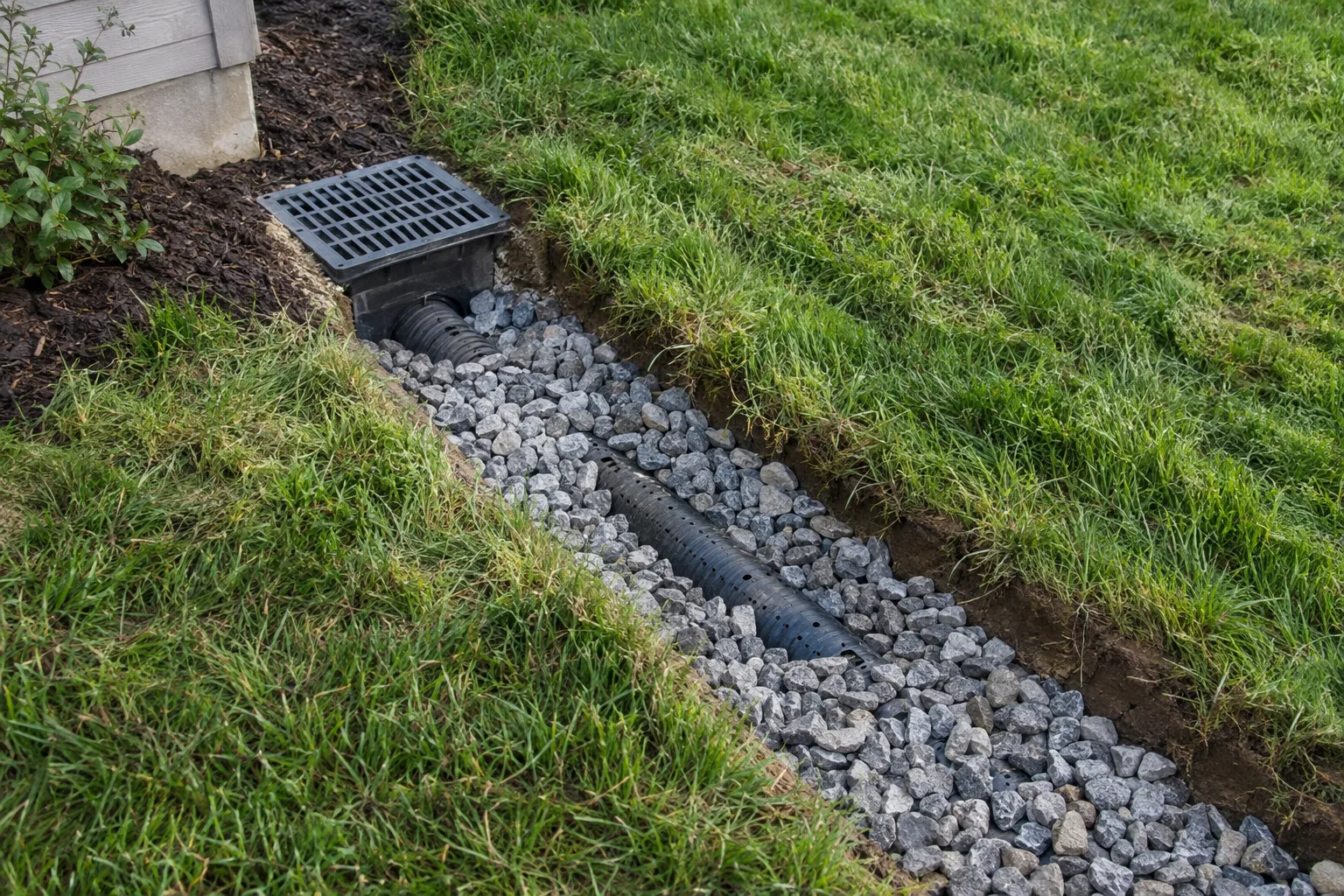
A catch basin collects at a low point
A catch basin intercepts runoff at a low point. Its grate elevation must match the surface, and its outlet must have enough downstream fall. Inlet capacity matters because a tiny grate can clog with leaves. It may be the better choice when the low point cannot practically be reshaped.
A French drain collects subsurface water
A French drain is a subsurface collector: water enters through soil and aggregate into perforated pipe or a drainage zone. It is not a substitute for an open grate that receives rapid surface flows. Fine sediment migration, a buried outlet or insufficient downhill slope can make a trench ineffective.
Some properties need a combination
Combination designs can use a shallow surface swale to move roof runoff while a separate interceptor handles slow seepage. Collection, conveyance and discharge should be treated as linked decisions, not three unrelated purchases. Make sure the proposed outlet can accept water without increasing downstream erosion.
Ask why the proposed approach fits
Arlington city guidance explicitly cautions against using perforated French drains for surface-water problems. Ask the contractor to explain why water will reach the selected system and how the collected water will leave.
How the clues change the decision
Imagine two low areas. The first fills rapidly because a patio sheds water across the grass during heavy rain; the second develops a narrow wet line along the base of a cut slope even after the downspouts are redirected. The first may benefit from grading or a surface inlet because its water crosses the ground. The second may call for investigation of subsurface seepage, where a well-located interceptor could be appropriate. Neither decision is complete without an outlet. The illustrative comparison also shows how two kinds of drainage can coexist on one property: a surface swale may keep roof runoff away from a building while a separate subsurface system serves a genuinely different wet layer. The key is not to install everything at once. Identify which flow each component receives, where it empties, and whether that route is lawful and maintainable.
Use the symptom to narrow the options
We ask when the wet area develops before discussing a product. Water racing over a patio and into the lawn points toward surface collection or a better surface route. A wet band that persists in the ground can justify a different investigation. Neither observation proves the final design, but each changes the questions we need to answer. Starting with the name of a drain can lead to selecting materials before finding the source. Start with the route of the water, then choose the method that can actually intercept it.
Grading may avoid buried components where enough space and fall are available. It can also affect turf, beds and existing edges across a wider area. A basin limits collection to a point, so the surrounding surface must lead water there. A French drain places its collection area below ground, which makes location and depth important. These are practical tradeoffs, not a ranking from cheapest to best. We compare them against the property conditions and explain why a method fits before discussing how much of it to install.
Compare complete plans, not component names
Two estimates using the same drain name can describe very different work. One may include only a short collector while another includes the outlet pipe, grading and restoration. Ask where water enters each plan, how it travels and where it leaves. Also compare the effect on the usable yard. A surface swale needs to remain open; a basin needs cleaning access; a buried collector needs an appropriate outlet and a way to investigate problems. Those details can matter more over time than the visible size of the installation.
We also check whether a combination addresses separate sources or simply repeats the same job. Connecting a roof downspout to a subsurface collector without examining the added flow can make the system work differently from the intended design. A separate solid transport route may be more appropriate for roof water. Where grading and a basin are combined, the grading should guide runoff into the inlet rather than leave a competing low spot beside it. Each component needs a reason to be there, with a downstream route that supports the whole plan.