The outlet cannot empty
A perforated pipe does not create downhill flow. If its downstream invert rises or the outlet is submerged, the aggregate trench can store water rather than remove it. Water may then reappear near the surface after storms, making it look as though the drain has simply become clogged.
The trench misses the water
The collection trench must cross the actual subsurface wet zone. A pipe placed too high may miss seepage moving along a restrictive layer; a pipe installed far from the water path cannot pull saturated ground toward it. Position and outlet location deserve more attention than the label on the pipe.
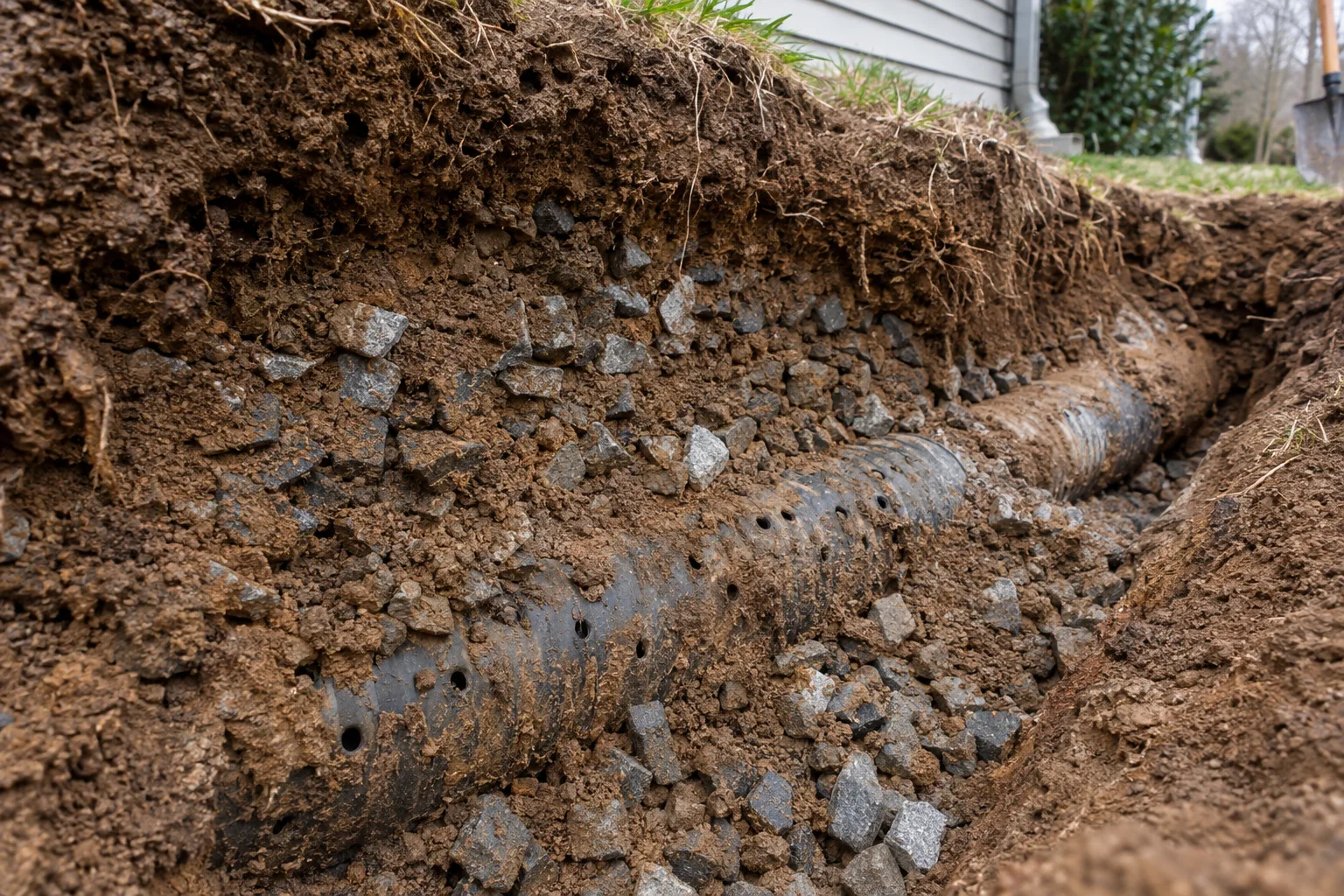
Sediment blocks the collection area
Fine particles can migrate into the aggregate and openings over time. Material selection and appropriate separation details depend on the surrounding soil. A bare perforated pipe placed in excavated soil without a compatible drainage envelope may fill with sediment; incorrect fabrics can create other limitations.
The problem is surface runoff
If the reported problem is rapid surface runoff from a patio or roof, a French drain may be the wrong device entirely. The City of Arlington specifically distinguishes groundwater-oriented French drains from surface collection. Surface grading, a basin or a different conveyance layout may be more suitable.
Decide between cleaning, repair, and redesign
Inspection starts with a timeline: when did performance change, was landscaping altered, do cleanouts exist, and is the outlet reachable? A local blockage might be repairable; no fall or a fundamentally misplaced trench can require a redesigned route.
Ask what the repair will change
Ask for diagnosis before trench replacement. Useful evidence includes levels at accessible points, outlet conditions, signs of sediment, and whether the water behaves like subsurface seepage. Without a clear failure mechanism, reinstalling the same layout risks reproducing the issue.
How the clues change the decision
Consider a gravel trench that worked briefly and then began leaving a soggy strip near its outlet. Three checks could lead to very different repairs. First, verify whether the terminal is physically open and set low enough. Second, see whether surrounding fines have restricted movement into the drainage zone. Third, check whether the original subsurface water line still intersects the trench. If the outlet is blocked, opening it may restore movement; if the collection elevation is wrong, cleaning cannot put it in the path of seepage. If the original complaint was stormwater running across the lawn, the installation might never have been suited to the task. This decision sequence is more defensible than ordering a replacement trench solely because the visible surface is wet.
Identify which part stopped doing its job
A French drain has a collection area, a route for the collected water and a receiving point. Failure at any of those parts can leave the ground wet, but the repairs differ. We first ask whether the trench ever improved the original problem and what changed before performance declined. An outlet covered during landscaping offers a different explanation from a trench that never intersected the wet layer. That history helps us investigate the system in a useful order instead of assuming every damp strip means the whole installation needs replacing.
A blocked or damaged transport section can restrict a collector that is otherwise sound. Conversely, a clear outlet does not prove water is reaching the collector through the surrounding soil. We distinguish those questions before selecting cleaning or excavation. If the original complaint was fast runoff crossing the lawn, the collection method may have been mismatched from the start. Restoring a subsurface trench will not necessarily capture a sheet of water passing over it. The repair recommendation should explain which of these mechanisms the evidence supports.
Avoid repeating the same unsuccessful repair
Ask what changed after each previous attempt. Did cleaning restore flow for a short time? Did an extension move the wet spot farther down the yard? Did new sod cover the outlet? Those details can reveal a recurring source of sediment, an unsuitable receiving area or a surface obstruction. We also consider whether roof water has been added to a line originally intended for another source. The extra demand can change performance even though the pipe and trench materials have not visibly deteriorated.
A repair scope should identify the failed section, what will be exposed and how the remaining system will be checked. If the route has insufficient fall or the collector sits in the wrong location, a redesign may be more useful than repeated small patches. Where a focused repair is appropriate, usable sections can remain. We discuss how the work will be verified and what to watch during later rain. The objective is a reasoned correction to the observed failure, with restoration included, rather than another trench installed on the strength of the same unsupported assumption.