Start with the available destinations
Water can sometimes be managed by surface swales, stable on-lot outlets, suitable infiltration systems or approved connections. Which destination is acceptable depends on lot grades, easements, property boundaries, receiving conditions and local municipal rules. The point of collection alone cannot make a plan complete.
Surface swales need a continuous route
For surface routing, the swale must have room for water to travel without gathering at doors, patios or neighboring boundaries. Finish elevations and landscaping need to maintain the intended low line after turf, edging or mulch is replaced. Outlets should not create ruts or wash away soil.
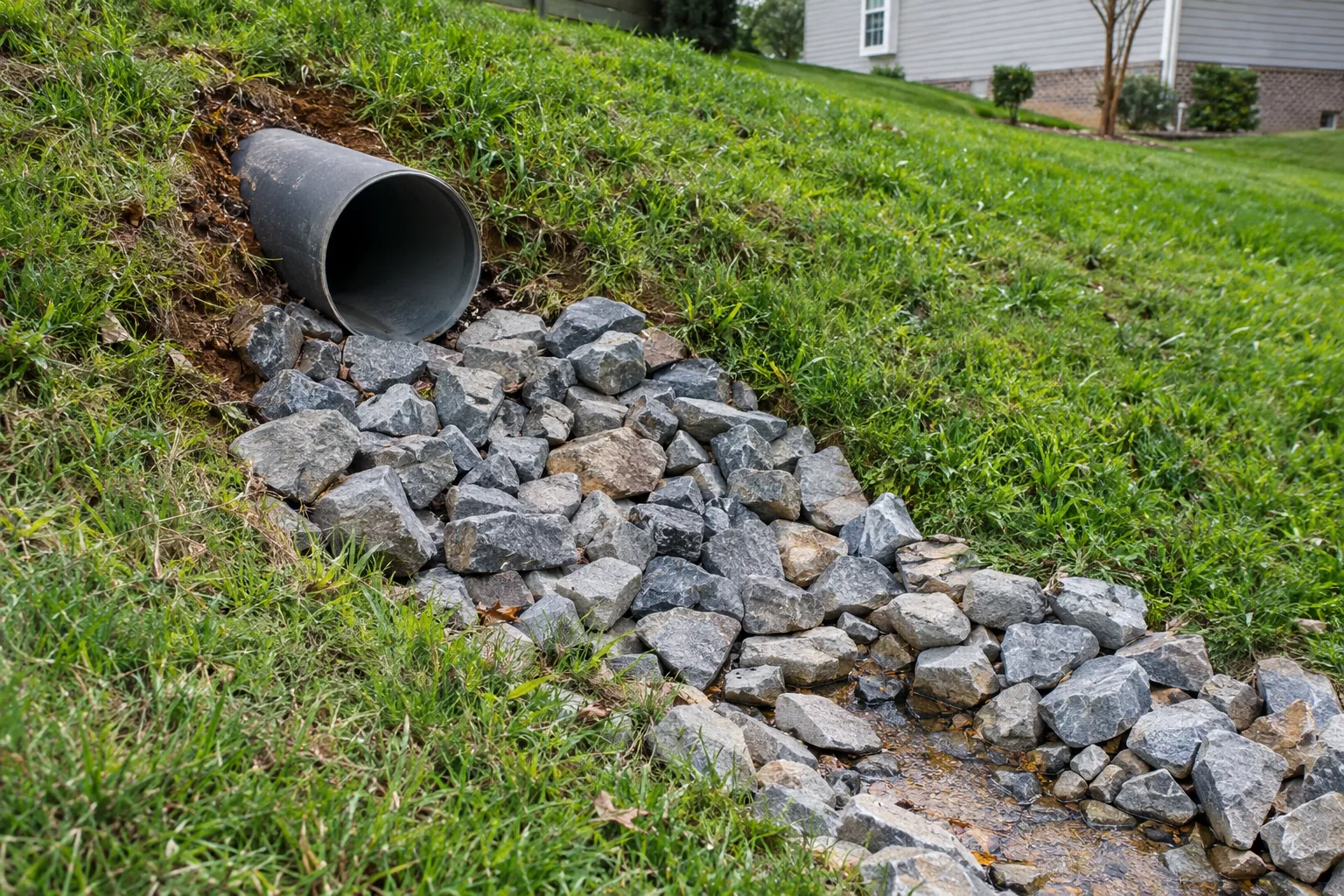
Buried pipes need usable fall
An underground solid line carries water from a catch basin or downspout to an exit location. Pipe material, access points and the actual invert elevation matter. A buried outlet may be visually unobtrusive but should remain locatable and serviceable.
Infiltration depends on the soil
Infiltration options such as a rain garden or dry well rely on available storage and soil permeability. A wet clay layer, high groundwater or nearby foundation may rule out a concept that looks appealing on a product diagram. Never assume the lot will absorb an unlimited volume of stormwater.
Check public connections and easements
In Arlington, public storm drains, channels, curb inlets and drainage easements do not automatically permit private tie-ins. Municipal resources distinguish privately maintained and public facilities. Proposed work affecting public assets or discharge arrangements should be verified with the appropriate office before construction.
Plan for water beyond the normal capacity
A complete proposal identifies a planned overflow behavior for large storms. The primary system may function during routine events yet exceed capacity during exceptional runoff; a safe overflow route reduces the chance that a blocked grate or undersized line sends water toward a building.
How the clues change the decision
For example, a property owner might have a low backyard with a planned catch basin but no visibly lower private outlet. A drawing that stops at the grate is incomplete. Running pipe to the curb could cross public right-of-way, and sending the flow over a neighbor’s fence would transfer the nuisance rather than resolve it. Before work, the owner would need to find an acceptable receiving point and understand any permits, easements or private rights along the route. If there is insufficient fall, a surface swale may also be limited; if soil accepts water slowly, a dry well could remain full after repeated storms. A design might require a different line, storage strategy or qualified engineering analysis. The important deliverable is a complete description of where water enters, travels, exits and safely overflows when the usual path is exceeded.
Work backward from the receiving point
We look for a usable destination before fixing the inlet positions. The lowest wet spot in a yard may be lower than the available outlet, which changes what a gravity system can do. A pipe route that looks direct from above may also encounter utilities, roots or paving. Considering those limits early avoids opening a trench for a route that cannot be completed as intended. The outlet is part of the design from the beginning, not a final fitting to be chosen after the rest of the installation.
The ground beyond an outlet matters too. Releasing water onto an unprotected slope can cause erosion, while discharging into another depression can create a new standing-water area. We examine where water will travel after leaving the pipe and whether that route remains accessible. Surface drainage has the same requirement: a swale needs to continue to a suitable receiving area rather than end at a fence. The proposed improvement should explain the whole route instead of stopping its drawing at the edge of the disturbed lawn.
Compare the limits of each approach
Infiltration offers a different destination, but the soil must be able to accept the water. A dry well stores water temporarily and needs time to empty. A rain garden adds a planted surface area with its own inlet and overflow considerations. Neither removes the need to evaluate the contributing runoff and nearby structures. We compare those options only where the site conditions support them. When the ground absorbs water slowly, a larger storage space can delay a backup without resolving the recovery problem between storms.
Before agreeing to work, ask which parts of the route are confirmed and which depend on further checks. A connection to a public feature, a route through an easement or a crossing beyond the property may need review or permission. We do not assume those routes are available because a pipe or ditch is visible. The written scope should identify the intended destination, access for future cleaning and the route for excess water. If the receiving point remains unresolved, the drainage plan is not ready to be treated as a complete installation.